
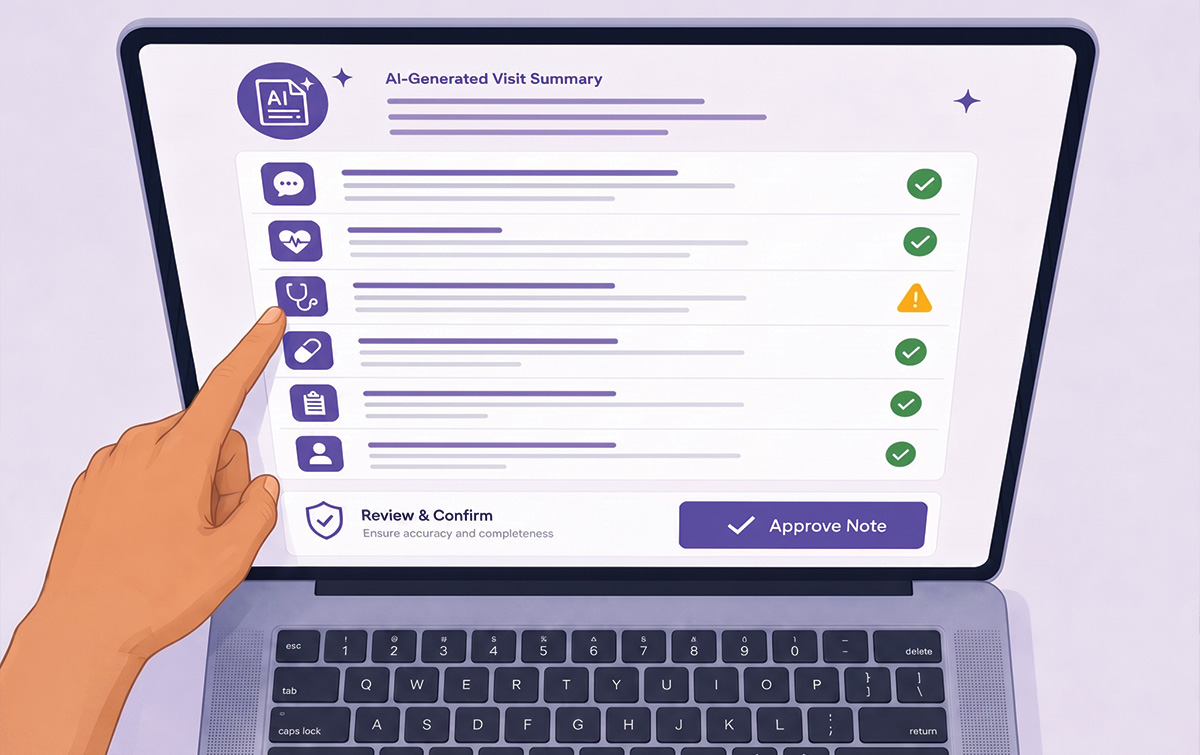
AI can make healthcare work look finished.
A visit note can be structured. A summary can be clean. A task can be drafted in the right format. At first glance, the output may look ready to move forward.
But in healthcare operations, looking complete is not the same as being ready.
That is one of the bigger challenges organizations face as AI becomes part of daily work. The technology can produce useful output, but that output still has to fit the workflow it supports.
A note may summarize the visit clearly but miss the treatment history needed for payer review. A draft may follow the right format but leave out context from a prior encounter. A recommendation may be useful but still need to be checked against policy, documentation standards, or the realities of the patient’s record.
The issue is not always that AI produced something wrong.
Often, the issue is that healthcare work depends on context.
Healthcare Work Does Not End at the Output
AI is useful because it can organize information quickly. It can reduce blank-page work, create consistency, and help teams move faster.
That matters in a healthcare environment where administrative work keeps growing.
But most healthcare workflows do not stop once something is generated. A note may support a prior authorization. A summary may guide a follow-up call. A task may affect billing, documentation, care coordination, or the next action in the patient journey.
That means the output has to do more than look polished.
It has to be usable for the next step.
This is where the gap often appears. AI can create the document, summary, or recommendation, but it may not always know what another team, payer, system, or process will need later.
The Missing Context Is Often Small
The gap is not always obvious.
It may be one prior medication trial. One sentence from an earlier visit. One detail about why a treatment changed. One piece of history that explains why the current plan makes sense.
On its own, that detail may look minor. In the workflow, it can matter.
If the missing context is not caught early, it can create rework later. The team may need to reopen the chart, correct the documentation, answer a clarification request, respond to a denial, or track down information that should have been included before the work moved forward.
That is why AI review cannot only focus on whether the output reads well.
The better question is whether the output is ready for what it needs to support.
Human Oversight Is Part of the Workflow
Human oversight is sometimes described as a safety net. But in healthcare operations, it should be more than that.
It is part of how work moves responsibly from one step to the next.
A reviewer is not just looking for grammar issues or formatting problems. The reviewer is asking practical questions:
Does this include the right context?
Does it reflect what is already in the record?
Does it support the next action?
Is anything missing that could create confusion, delay, or rework later?
These are workflow questions, not just documentation questions.
And they are difficult to answer without human judgment, especially when the relevant information may be scattered across notes, systems, payer rules, or prior interactions.
The Real AI Challenge Is Operational
A lot of AI discussion in healthcare focuses on the tool itself.
How accurate is it?
How much time can it save?
How well does it summarize or draft?
Those questions are important, but they are not the whole issue.
The harder question is operational: what happens after AI generates the work?
Who reviews it?
What standard are they using?
When is the output ready to move forward?
What happens when context is missing?
Without clear answers, teams may end up with clean outputs that still create problems downstream. The work looks done, but the workflow is not protected.
That is where trust can start to weaken. Not necessarily because the technology failed, but because the process around it was never clearly defined.
Complete Is Not Always Ready
AI can help healthcare teams produce cleaner, more consistent work. That is useful.
But healthcare operations require more than generated output. They require context, review, judgment, and follow-through.
A note is not ready simply because the sections are filled in.
A summary is not ready simply because it is easy to read.
A task is not ready simply because it follows the right format.
It is ready when it can support the next step in the workflow.
That is the distinction healthcare organizations need to pay attention to as AI becomes part of daily operations.
Because the goal is not just to produce the work faster.
The goal is to make sure the work is ready to move forward.