
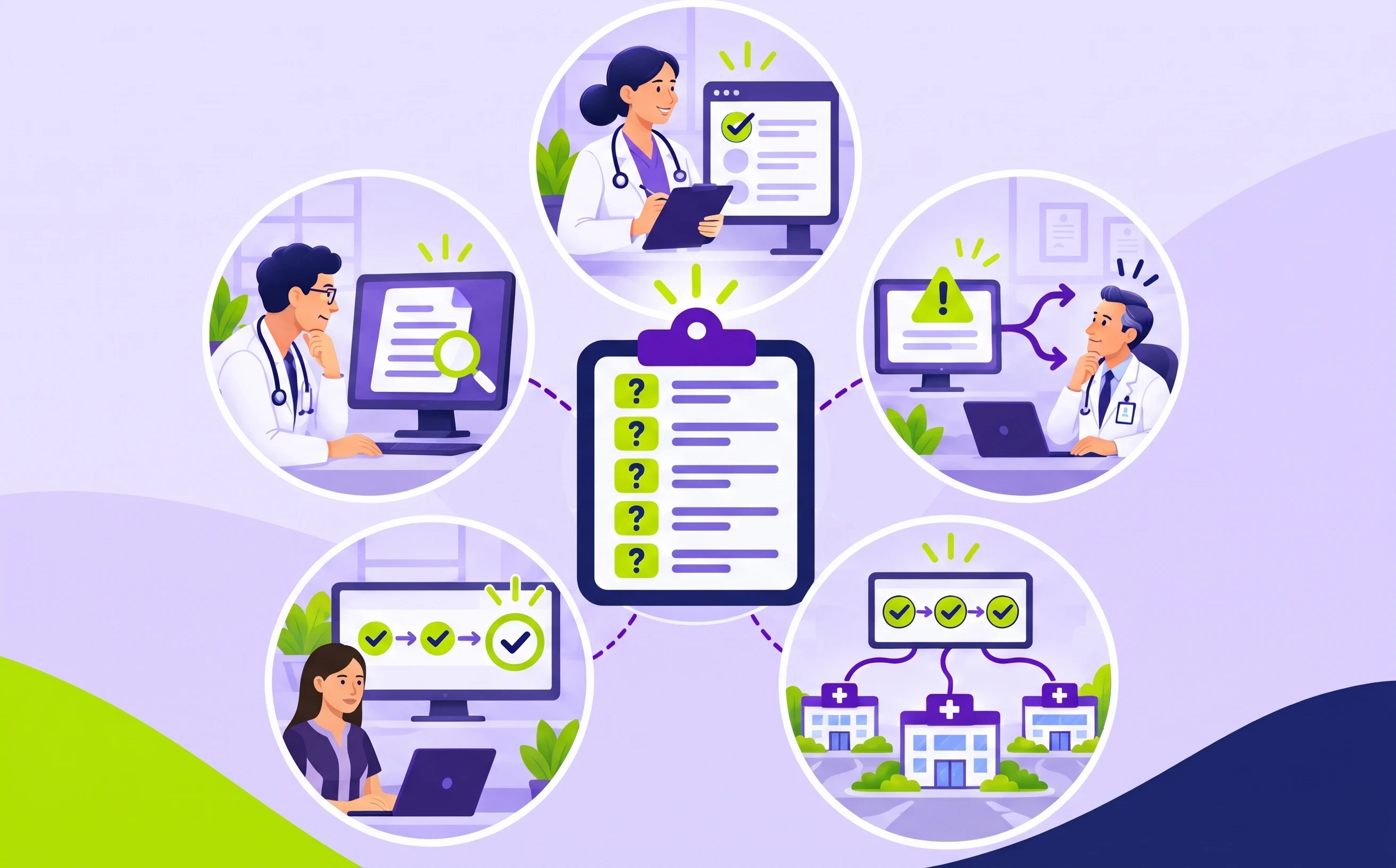
AI can take on more administrative work. Before expanding it across teams and locations, healthcare leaders need to know who verifies the output, how errors are detected, where exceptions go, and how completion is confirmed.
Healthcare organizations are introducing AI into administrative workflows to organize information, prepare documentation, and route tasks more efficiently.
But automation also changes how work moves between people and systems, and who is responsible for what happens next.
Consider a prior authorization request. AI may assemble the required information, but the documentation could still contain an inconsistency or need clinical clarification. Someone must recognize the issue and determine the appropriate next step.
As we explored in AI Output Is Not the Same as Workflow Readiness, a completed output is not necessarily ready for the next stage of work.
Across health systems and multisite medical groups, differences in staffing, systems, and procedures make this challenge more complex.
Effective oversight does not require identical review of every automated action. It requires clear review standards, accountable owners, and ways to identify errors that automation may fail to flag.
1. Who Owns the Work After AI Produces an Output?
An AI-generated referral, patient message, or authorization packet is not the end of the process. Each still needs a defined next step.
Who checks whether the information is ready? Who submits it? Who follows up when additional information is requested?
Without clear ownership, tasks can remain unresolved between systems and teams even when the automated step appears successful.
This matters when work crosses departments. A referral may involve scheduling staff, authorization specialists, clinical personnel, and an outside provider.
Before expanding AI, define who owns each handoff, who can act on the information, and who remains accountable when a task is unresolved.
Not every automated action requires individual review. Work that needs attention does need an identifiable owner.
2. Which Situations Require Human Review?
Human oversight should reflect the complexity and risk of the work, rather than being applied identically to every task.
A routine appointment confirmation is relatively predictable. A prior authorization involving payer-specific criteria or conflicting documentation requires a different level of attention.
Take a prior authorization involving step therapy.
AI assembles a patient's documented treatment history into an authorization packet. The packet appears complete, but the payer requires evidence that treatments were attempted in a particular order.
A designated reviewer verifies that the packet accurately reflects the sequence documented in the clinical record and checks it against applicable payer requirements.
If information is missing, inconsistent, or requires clinical interpretation, the reviewer escalates the issue to an authorized clinician.
The reviewer does not make treatment decisions. Their responsibility is to identify the documentation issue and route it appropriately.
Organizations should define specific review triggers, including missing information, conflicting records, requirements outside established rules, and questions requiring clinical judgment.
They also need a method for checking errors that automated systems do not flag. For lower-risk work, validated sampling may become appropriate over time; higher-risk cases may continue to require more intensive review.
Review belongs at the points where it matters.
3. What Happens When a Workflow Cannot Proceed?
Recognizing an exception is only the beginning. The next question is who takes responsibility for resolving it.
A payer may request additional documentation. A referral may be returned for missing information. A patient message may require clinical input.
Flagging the issue does not complete the work. Someone must determine the next step, assign responsibility, and track progress.
Xillium has seen this firsthand in referral operations, even before AI entered the workflow. In one engagement, the previous referral team had left without a documented handover. Establishing a new process required more than assigning staff to a queue.
"When we started on the referral work, there was no documented handover. We worked with the client to build the workflow from scratch and get it approved before implementation. From there, we continued reviewing workloads and recommending adjustments as demand changed."
Ana Victoria Ledesma
Senior Account Manager, Xillium
The experience illustrates an important operational principle: establishing a workflow is not enough. Someone must monitor how it performs, recognize changing conditions, and coordinate adjustments.
In AI-supported operations, the same discipline is necessary. When automation identifies an exception, the workflow needs a defined owner, an escalation path, and a way to track the unresolved task.
Exception handling should not depend on individual employees knowing whom to contact. It needs to be built into the operating process.
4. How Will the Organization Know That Work Was Completed?
AI systems may report how many documents were prepared, requests classified, or tasks processed. These are useful activity measures, but they do not necessarily show whether the intended work was completed.
Imagine an AI tool prepares 200 prior authorization packets.
How many were submitted? How many required correction? How many remain unresolved?
The initial output provides only part of the answer.
For prior authorizations, preparing documentation, submitting the request, receiving the payer's response, and recording its disposition are distinct stages.
Similarly, a referral marked as processed may still require additional follow-up.
Healthcare organizations need to distinguish between activity, progress, and completion.
That means defining completion criteria, tracking outstanding tasks, and documenting reviews, corrections, and escalations.
An audit trail shows what actions occurred. Operational visibility helps leaders understand whether work is progressing toward its intended outcome.
A successful automated step is useful. It should not be confused with a completed workflow.
5. Can the Same Standards Work Across Multiple Locations?
A workflow that works in one practice may operate differently across a health system or multisite organization.
Locations can vary in EHR configuration, staffing, payer requirements, and escalation procedures. A newly acquired practice may follow an entirely different process.
Deploying the same AI tool across those locations does not automatically standardize how work gets done.
As we discussed in Designing Healthcare Operations Support Around Real-World Needs, operational support needs to account for how work actually happens.
Organizations should identify which responsibilities must remain consistent and where local differences are necessary.
For example, the criteria for identifying an incomplete authorization request can be standardized, even if different locations gather supporting documentation differently.
The same applies to ownership. Every unresolved task should have an assigned owner, although the responsible team may vary by location.
Controls also need to be reassessed when the technology or workflow changes. A model update, a revised payer rule, or expansion to a new location may require renewed validation of review triggers, sampling standards, and escalation paths. Past performance alone should not be treated as approval for a changed process.
Standardization means consistent accountability, not identical procedures everywhere.
A Practical Readiness Check
Before expanding AI across additional teams or locations, healthcare leaders should be able to answer:
- Ownership: Who is responsible after an automated step?
- Review: What conditions require human attention?
- Escalation: Where does unresolved work go, and who follows up?
- Completion: How do we confirm the intended outcome?
- Consistency: Can these standards be maintained across locations?
If the answers are unclear, start with one workflow. Map its handoffs, identify the exceptions that require human attention, and define responsibility before expanding automation.
The exercise reveals the operational gaps technology alone won't close.
Where Human-Assured™ AI Operations Fits
At Xillium, these questions inform Human-Assured AI Operations, an approach to structuring trained human oversight around AI-supported healthcare administrative workflows.
The approach centers on three responsibilities:
- Human Review: Identify information and exceptions requiring human attention and check whether automation has missed problems.
- Exception Handling: Direct unresolved work to the appropriate person or team, including clinical personnel when necessary.
- Operational Follow-Through: Maintain accountability for administrative follow-through until the task reaches an appropriate outcome.
These responsibilities rely on trained personnel, defined workflows, and operational oversight.
Technology can move work. People still own the exceptions.
For healthcare organizations considering broader AI adoption, the question is not only what technology can automate. It is whether the people, processes, and accountability are in place to support what comes next.
Explore Xillium's Human-Assured™ AI Operations approach to learn how we structure human accountability around AI-supported administrative workflows.